Crane hook wear limit guidelines
2025-08-27
In the world of heavy lifting, the crane hook is the ultimate endpoint of trust. It’s the singular piece of hardware that connects your priceless load to the complex machinery of the crane. Yet, it’s often taken for granted. Unlike a worn wire rope that’s easy to spot, hook wear can be insidious, progressing gradually until it poses a catastrophic risk.
Understanding and regularly checking for crane hook wear limits isn’t just a recommendation—it’s a fundamental pillar of operational safety and compliance with standards like OSHA and ASME B30.10.
This guide will walk you through the key wear points, how to measure them, and the critical limits that dictate when a hook must be taken out of service.
Why Hooks Fail: The Anatomy of Wear
A hook fails primarily due to three reasons:
- 1. Overloading: Exceeding the rated load capacity, which can cause plastic deformation (the hook bending or stretching).
- 2. Fatigue: Repeated loading and unloading, even within rated capacity, can lead to the development of cracks over time.
- 3. Wear and Abrasion: The constant contact with slings, shackles, and the load itself grinds away material, reducing the hook’s cross-section and strength.
It’s this third point—wear—that requires vigilant inspection.
Key Areas to Inspect for Wear
Focus your inspection on these three critical areas of the hook:
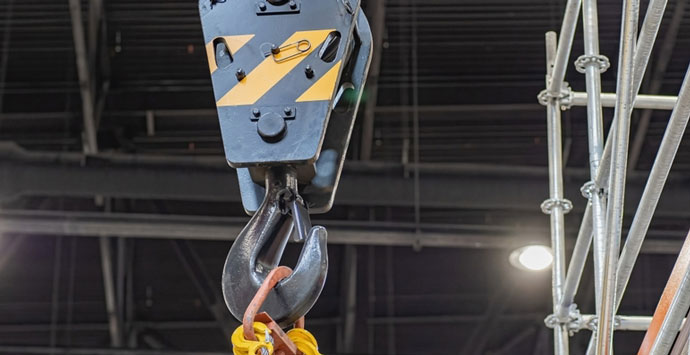
- 1. The Throat (Saddle or Load-Bearing Point): This is the curved inner section that directly supports the load. Wear here reduces the depth of the groove and, critically, opens up the hook’s throat, making it easier for a sling to slip out.
- 2. The Point (Tip or End): The tip of the hook can become worn down or bent from improper use (e.g., “point loading” or dragging on the ground).
- 3. The Shank (Bail or Eye): The area where the hook connects to the hook block or collar. Check for wear where it contacts the swivel bearing or other fittings.
How to Measure Wear: The 15% Rule and More
The most widely accepted guideline for hook wear comes from standards like ASME B30.10. The core principle is that a hook must be removed from service if any of the following conditions are met:
1. Throat Opening Increase:
- The Rule: Any increase in the throat opening over 15% of the original manufacturer’s specification is cause for rejection.
- How to Check: You must know the original dimension (O) of the throat opening. This is typically stamped on the hook or available from the manufacturer’s datasheet. Measure the current, worn dimension (W). Calculate the percentage of increase: ((W – O) / O) x 100%.
- Example: If the original throat opening was 4 inches, a 15% increase would be 0.6 inches. Therefore, if the current measurement is 4.6 inches or more, the hook is condemned.
2. Wear on the Load-Bearing Point:
- The Rule: Wear on the load-bearing point (the saddle) must not exceed 10% of the original section height.
- How to Check: This requires a visual comparison against the hook’s original profile. Many manufacturers provide wear gauges or templates specifically designed for their hook models. Using a caliper or depth gauge, you can measure the depth of the worn groove and compare it to the original.
3. Deformation, Twisting, or Cracking:
- The Rule: Any visible twisting, bending, or cracking is an immediate cause for rejection. A hook that is bent or twisted is under abnormal stress and is highly unpredictable.
- How to Check: Visually inspect the hook from the side. The tip of the hook should be in line with the centerline of the shank. Any deviation indicates bending. Use a magnetic particle test (MPI) or dye penetrant test (DPI) to find hidden surface cracks.
4. Corrosion and Pitting:
-
While not strictly “wear,” deep corrosion and pitting can significantly reduce the structural integrity of the hook by creating stress concentration points. If pitting is severe enough to compromise the hook’s strength, it must be replaced.
A Simple Inspection Checklist
Before every shift, perform a basic visual inspection. Before each lift, do a functional check. Regularly, a documented inspection should be performed by a competent person.
- 1. Check for Labels: Is the hook marked with its rated capacity? Is it legible?
- 2. Visual Scan: Look for obvious bends, twists, or deep cracks.
- 3. Throat Opening: Does the opening look wider than normal? (Use measuring tools for the formal inspection).
- 4. Wear Groove: Is there a deep, polished groove worn into the saddle?
- 5. Hook Latch: If equipped, is the latch functioning correctly, not worn, and not sprung? A damaged latch is a major safety hazard.
- 6. Swivel Mechanism: Does the hook swivel freely without excessive play or binding?

The guidelines above are a foundation, but always defer to the original manufacturer’s specifications, as they can sometimes be more conservative.
There is no such thing as a “slightly safe” hook. The cost of a new hook is negligible compared to the cost of a failed lift—which can include equipment damage, project delays, environmental harm, and most importantly, loss of life.
Make hook inspection a non-negotiable part of your lifting routine. Train your team, use the right tools, and cultivate a culture where anyone can—and must—red-tag a questionable hook without hesitation. It’s the strongest link in your safety chain.




Latest Comments